Email Nestle over violations of the international marketing standards

Share this

Updated 16 February 2013

Send an email to Nestle. Nestle is promoting its baby milk with the claim it 'protects' babies. But babies fed on it are more likely to become sick than breastfed babies and, in conditions of poverty, more likely to die.
In the Philippines, Nestlé is part of an industry association trying to weaken the baby milk marketing regulations in a country where the World Health Organisation says 16,000 babies die every year due to inappropriate feeding (please sign the petition on the AVAAZ website about this).

The images below show how Nestle promotes its breastmilk substitutes to parents and health workers. There is also a short clip  where Mr. Henry Nastie, spoof marketing guru, explains the strategy. After thousands of emails Nestlé says it has discontinued the leaflet shown below that claimed its formula is 'The new "Gold Standard" in infant nutrition'. Campaigning works, but this is one of just four violations Nestlé has agreed to stop in the 130 it counted in the latest global monitoring report from the International Baby Food Action Network (IBFAN). In other words it is only taking action on 3% of violations and intends continuing with other prohibited practices - further pressure is needed.

(Tip - you can return to this page to share it with your friends by clicking 'Email Nestlé' in the left menu).

Share this link with your friends on Facebook and by using the email feature on the left or foot of page. You can also embed the clip below on your own site or blog using the youtube code. Remember to join Baby Milk Action's Facebook group and invite friends to events.

Send a message to Nestlé via Baby Milk Action

This is addressed to Nestlé's Global Head of Public Affairs, Dr. Gayle Crozier-Willi, who has been defending these marketing strategies (see below).

Enter your name here:

Enter your email address here:

Re-type your email address here:

Subject (feel free to edit):

Draft message (feel free to edit - you can delete the last sentence if you are not boycotting Nestlé):


Alternatively, you can submit a message via Nestlé's website. There is a suggested letter to send to Nestlé and further details on the Campaign for Ethical Marketing action sheet.

Updates

Latest Updates:

26 January 2013: Nestle infiltrated campaign group - court orders payment of damages and costs

3 December 2012Nestle and co's US$400 million threat against the Philippines

28 May 2012: In the Philippines, Nestlé is part of an industry association trying to weaken the baby milk marketing regulations in a country where the World Health Organisation says 16,000 babies die every year due to inappropriate feeding. Further details at: http://info.babymilkaction.org/philippines2012

20 April 2012: Nestlé has added an article to its anti-boycott website regarding violations in Armenia - see below.

April 2012: Indian Government targets illegal Nestlé activities - but is undermined by FTSE4Good

October 2011: Nestlé free samples, 'protect' logos and under-age labelling of cereals in Armenia

(other updates are below - click here)

Film clip - Nestle baby milk marketing strategy explained - click here if it is not displayed below.

Mr. Henry Nastie was played by Mike Brady of Baby Milk Action. Other people interviewed were campaign supporters who had come to demonstrate at Nestlé (UK) HQ on 22 May 2010.  If you prefer to read an article about Nestlé's strategy, see our press release. (You may also be interested in Mike's recent Q & A with Mumsnet on Baby Milk Action's work - click here).

The claims Nestlé makes about its formula do not stand up to scrutiny, are prohibited by international standards and even contravene food labelling laws in places such as South Africa - see references below.

[Left, How Nestlé promotes its breastmilk substitutes to health workers - this leaflet from Egypt June 2010 - with its 'protect' logo and the slogans 'Start healthy, Stay healthy' and  'Strengthening the immune defenses and reducing the incidence of diarrhea in the crucial first year of life.' In truth, babies fed on baby milk are proven to be more likely to suffer diarrhoea and short and long-term illnesses than breastfed babies. Below: Nestlé promotes its formula to health workers as 'The new "Gold Standard" in infant nutrition'.]


References:

1. Nestlé is the most boycotted company in the UK and one of the four most boycotted companies on the planet according to a 2005 survey by GMIPoll, reported in The Guardian newspaper on 1 September 2005. Nestlé is the target of a boycott because monitoring by the International Baby Food Action Network (IBFAN) finds Nestlé, the market leader, to be the worst of the baby food companies. The boycott has forced Nestlé to make changes - see some examples here. In the case of Malawi, in the past Nestlé refused to translate the required warnings into Chichewa, the national language, citing 'cost restraints'. It backed down after Baby Milk Action targeted this and Mark Thomas exposed Nestlé on his national television programme in 1999 - watch on youtube.

2. Nestlé claims it has reissued its instructions to distributors regarding prohibition of point-of-sale display of formula after Baby Milk Action contacted it about the display in a rural area of Malawi shown in the film. Not only does the display reveal that Nestlé systems are failing, it suggests that distributors may see no risk in promoting formula with the 'protect' logo even in the poorest of conditions if they believe it will 'protect' babies. Under-5 mortality in Malawi is 140 per 1,000 live births.

3. Nestlé (UK) HQ is in Croydon. Campaigners demonstrate every year on the anniversary of the adoption of the International Code of Marketing of Breastmilk Substitutes, adopted by the World Health Assembly in 1981.

4. According to UNICEF: "Improved breastfeeding practices and reduction of artificial feeding could save an estimated 1.5 million children a year" and "Marketing practices that undermine breastfeeding are potentially hazardous wherever they are pursued: in the developing world, WHO estimates that some 1.5 million children die each year because they are not adequately breastfed. These facts are not in dispute." The 2003 WHO/Lancet Child Survival Series asked 'How many child deaths can we prevent this year?' and concluded that 1.3 million under-5 deaths in the 42 countries where most occur could be prevented by improved breastfeeding rates. See Your Questions Answered. According to WHO (2006): "The protection, promotion and support of breastfeeding rank among the most effective interventions to improve child survival. It is estimated that high coverage of optimal breastfeeding practices could avert 13% of the 10.6 million deaths of children under five years occurring globally every year. Exclusive breastfeeding in the first six months of life is particularly beneficial, and infants who are not breastfed in the first month of life may be as much as 25 times more likely to die than infants who are exclusively breastfed."

5. Baby Milk Action contacted Nestlé about its 'Protect' logos in July 2009 and asked members of the public to do the same, using its Campaign for Ethical Marketing action sheet. Nestlé posted a public response to its website in October 2009 following the public campaign and responded to Baby Milk Action after being reported to the UN Global Compact Office for breaching its principles. Nestlé defends the logos. A full analysis is available here.

6. The UN Global Compact Office has said it can do nothing of the violations of its principles other than encourage 'dialogue'. It also stated: "Of course, abuses of the 10 Principles do occur; however we believe that such abuses only indicate that it is important for the company to remain in the Compact and learn from its mistakes." Nestlé uses its involvement in the UN Global Compact in its Public Relations campaigns to try to divert criticism. Baby Milk Action also reported Nestlé over the 'protect' logos to the Swiss Government department responsible for enforcing the OECD Guidelines for Multinational Enterprises. The Swiss Government also said it was unwilling to do anything other than promote 'dialogue'. Baby Milk Action asked it to request samples of the latest baby milk labels from the countries where the formula has been launched - it refused to do so and said it was closing the case. Further details here.

7. Baby Milk Action raised the 'protect' marketing campaign and other issues at the Nestlé shareholder meeting on 15 April 2010. Mr. Richard Laube, Chief Executive of Nestlé Nutrition, defended the logos and said they had been launched in 120 countries.

8. We campaigned when Nestlé launched its 'protect' logos in South Africa in 2008. The South African Department of Health told us:

The Department of Health are extremely concerned about all the health claims that Nestle make on the new NAN 1, 2 and 3 tins. The health claims are a contravention of the current South African Regulations. A meeting was held with representatives of Nestle and Department of Health and it seems they were not aware that they are transgressing the Regulations. However, they are reluctant to change the labels.

9. Nestlé's Global Public Affairs Manager, Dr. Gayle Crozier-Willi, said in correspondence with Baby Milk Action on 14 January 2010:

Nestlé makes significant investment in R&D and technology to deliver innovative products with scientifically proven nutritional benefits in many different areas. Concerning the 'Protect' logo, while all our infant nutrition products meet the needs of non-breastfed babies during the first critical months of life, the functional benefits that are encapsulated in the 'Protect' logo are the result of many years of intensive research on how best to improve the nutritional composition to stimulate the infant's immune system. The logo helps distinguish this particular formula from other less advanced products but does not claim in any manner that infant formula is superior to breast milk.

The 'proven' nature of the claims is disputed by independent reviewers (see below). In addition, all idealizing claims are prohibited by Article 9.2 of the International Code, which states: 

Neither the container nor the label should have pictures of infants, nor should they have other pictures or text which may idealise the use of infant formula. [emphasis added]

Article 11.3 states:

Independently of any other measures taken for implementation of this Code, manufacturers and distributors of products within the scope of this Code should regard themselves as responsible for monitoring their marketing practices according to the principles and aim of this Code, and for taking steps to ensure that their conduct at every level conforms to them.

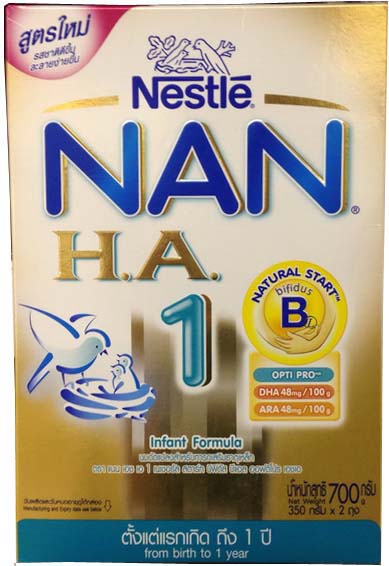
The colourful logo, which says 'Protect Start' on the infant formula for use from birth and 'Protect Plus' on the follow-on formula for use from 6 months and the terms DHA, ARA, Opti-Pro and Bifodigenic effect. Analysis:

• DHA and ARA are Long Chain Polyunsaturated Fatty Acids LCPUFAs. According to the respected Cochrane Library: "It has been suggested that low levels of long chain polyunsaturated fatty acids (LCPUFA) found in formula milk may contribute to lower IQ levels and vision skills in term infants. Some milk formulas with added LCPUFA are commercially available. This review found that feeding term infants with milk formula enriched with LCPUFA had no proven benefit regarding vision, cognition or physical growth." http://www2.cochrane.org/reviews/en/ab000376.html

• Bifodigenic effect appears to be suggesting the formula contains an oligosaccharide - sometimes marketed as 'prebiotics' - (breastmilk contains over 100) to promote bacteria growth and provide protection against allergies. The Cochrane Library concluded a review: "There is insufficient evidence to recommend the addition of prebiotics to infant feeds for prevention of allergic disease or food reactions." http://www2.cochrane.org/reviews/en/ab006474.html

• Opti-Pro implies a benefit for eyes (until recently, Nestlé owned marketed Opti-Free contact lens solutions) or 'Optimum Protein', itself an idealising claim. Nestlé's Dr. Crozier-Willi, said in her letter of 14 January 2010:

The logo 'Opti-pro' does not refer to eye development at all, rather it refers to an optimised mix of milk proteins which when ingested, results in the infant having a blood amino acid composition which closely resembles that of an infant on breast milk. This represents quite an advance in the application of technology to superior nutrition and is explained in detail in the scientific information that we share with health professionals.

Article 7.2 of the International Code states: "Information provided by manufacturers and distributors to health professionals regarding products within the scope of this Code should be restricted to scientific and factual matters, and such information should not imply or create a belief that bottle feeding is equivalent or superior to breastfeeding."

9. All of Baby Milk Action's posters had been removed from outside Nestlé (UK) HQ when it returned to remove them itself after packing up after the demonstration. Nestlé representatives, though generally calm and collected in public (unlike Mr. Nastie), are aggressive in trying to remove criticism. For example, Baby Milk Action was threatened with legal action by Nestlé prior to the launch of the Nestlé Critics website during International Nestlé-Free Week in 2008 - click here. In March 2010, Nestlé forced youtube to remove a Greenpeace film clip exposing the harm caused by the company's sourcing of palm oil - click here. Nestlé has also been accused of spying on campaigners in Switzerland - click here.

Updates

20 April 2011: Nestlé has added a page to its anti-boycott website regarding violations in Armena, a country it classifies as high risk, the day after Baby Milk Action raised concerns at the Nestlé shareholder meeting. The page, which has been given a date of 29 November 2011 states: "In these ‘higher-risk’ countries, we do not advertise or promote baby milks for babies below one year of age. Our growing-up milks, such as NAN 3, are milks adapted to the nutritional requirements of young children above the age of one year."

Previously Nestlé stated it would not advertise milks for older babies except "in the rare instances where they have brand/label design which is distinctly different from infant formula."

As Nestlé's promotional flier for the milks in Armenia shows (left) the brand/label is identical across the range, except for the number 1, 2, 3 or 4.

11 January 2011: Nestlé finally admits that ingredients highlighted in its logos, such as DHA and ARA, have 'no proven benefit'. See Update 43. Take part in our Crowdsourcing experiment by delving into Nestlé's justification for continuing to use the logos regardless - click here.

10 October 2010: Press release on International Nestle-Free Week (25 - 31 October) - a peg for promoting the email campaign. Let's keep up the pressure.

9 July 2010: Nestlé latest response analysed - with suggested reply. 

29 June 2010: The parallel realities of what Nestlé says it does and what it really does

Nestlé has updated its anti-boycott website. The site includes a section Breastfeeding is Best, which states: "Nestlé agrees with the World Health Organisation (WHO) and other leading medical and health associations that breast-milk is the best and most natural food for babies." 

Breastmilk is sometimes described as 'The Gold Standard'. In its response to this email campaign, Nestlé says, 'There is no question about breast-milk being the best start a baby can have in life.'

As Nestlé steps up its public relations effort to try to convince that it fully supports the 'breastfeeding is best'message, out on the ground it was promoting its breastmilk substitutes as the 'new "Gold Standard" in infant nutrition' - as on this promotional pamphlet targeting health workers in Dubai. After thousands of emails from people like you, Nestlé says it has discontinued this leaflet. But it continues with other prohibited practices, such as making claims regarding risks of allergies etc. that do not stand up to scrutiny - see references below. 

Nestlé promises 'active immunity' in the prominent red flash (left). The text almost too small to read at the bottom of the back of the pamphlet gives the required information, "The World Health Organisation has recommended that pregnant women and new mothers be informed of the benefits and superiority of breastfeeding..."

This is the reality of Nestlé's commitment to theInternational Code!

According to industry analysts Euromonitor, Nestlé's baby food sales have grown steadily over recent years, while those of leading competitors have declined.


23 June 2010 - Nestlé was promoting its baby milk to paediatricians in Egypt this month with the slogan: "Nutrition and Protection across the crucial first year of life" (left). More updates below - click here.

Media coverage : The Scotsman (22 June) 

 17 June 2010: Nestlé's standard message seems to have changed slightly. Dr. Gayle Crozier-Willi is now suggesting that: "the World Health Assembly does not formulate marketing standards – rather it makes health policy recommendations to Member States." Funny that. The Assembly introduced the International Code of Marketing of Breastmilk Substitutes in 1981 and Article 11.3 states companies should ensure they comply with the Code independently of anything governments might do (download the Code here). In addition, Dr. Gayle Crozier-Willi was leading Nestlé's delegation lobbying Health Ministers at the World Health Assembly last month and so she knows they adopted a further Resolution on 22 May that specifically: “CALLS UPON infant food manufacturers and distributors to comply fully with their responsibilities under the International Code of Marketing of Breastmilk Substitutes and subsequent, relevant World Health Assembly resolutions.” Nestlé is demonstrating its contempt for this call. Let it know if you think it should abide by the Assembly standards by sending the above email and asking friend and colleagues to do the same. More analysis in the comment below.

7 June 2010: Nestlé has started to respond to people sending emails, but is still refusing to remove the 'protect' logos (see comments).

7 June 2010: News just in from Botswana. Nestlé was promoting its baby milk with the claim it 'protects' babies at the Botswana Pharmaceutical Society Annual Conference last month.

Photo shows Nestlé Public Relations Manager from the Republic of South Africa at the International Convention Centre, Grand Palm Hotel, Gaborone, Botswana on13 May 2010.

In the past Baby Milk Action supported colleagues in Botswana when Nestlé was promoting its baby milk with the claim it 'counteracts diarrhoea'. Nestlé said it would restrict future materials to 'scientific and factual information'. See our June 2003 action sheet in the archive.  But now it is claiming its baby milk 'protects' babies and 'stimulates the infant’s immune system'.


Comments

Nestle response as of 17 June 2010

Have you had a response from Nestlé? If so, we'd love to see it and hear what you think.

We've seen a slight change from the Nestlé response being sent out since 4 June. Nestlé is still not responding to the points that its 'protect' logos undermine the obligatory 'breastmilk is best for babies message', are prohibited by the International Code of Marketing of Breastmilk Substitutes and are shameful, given that babies fed on the formula are more likely to become sick than breastfed babies and , in conditions of poverty, more likely to die. 

Nestlé is now trying to suggest that the Code does not apply to it. Dr. Crozier-Willi's latest response states: "For your information, the World Health Assembly does not formulate marketing standards – rather it makes health policy recommendations to Member States." 

Yet, Article 11.3 of the International Code states companies should abide by these provisions independently of government measures. On 22 May 2010, the Health Ministers gathered at the Assembly adopted a further Resolution, which specifically: "“CALLS UPON infant food manufacturers and distributors to comply fully with their responsibilities under the International Code of Marketing of Breastmilk Substitutes and subsequent, relevant World Health Assembly resolutions." 

As mentioned above, Dr. Crozier-Willi, Nestlé Global Public Affairs Manager, was leading Nestlé lobbying of Health Ministers at the Assembly as they discussed the problem of health claims like Nestlé's 'protect' logos. So she surely cannot pretend to be unaware of this latest Resolution, even if she ignores Article 11.3 from 1981.

Dr. Crozier-Willi also suggests "In all countries where the “Protect” logo is used, it is consistent with the local legislative and regulatory framework". This is simply untrue, as the example of the comments made to Nestlé by the Department of Health in South Africa, quoted above, show. 

Nestlé continues to demonstrate its contempt for the International Code and the world's health ministries as it continues to put its own profits before the lives of babies with this marketing strategy. More messages to Nestlé please!

Nestle response as of 4 June 2010

Dr. Gayle Crozier-Willi is saying nothing new in her response on this issue so far. These points have already been addressed above. Baby Milk Action comments in square brackets [** like this].

--- Nestle response


There is no question about breast-milk being the best start a baby can have in life. To emphasise this, the following statement, "Important notice: Breast-milk is best for babies. Before you decide to use an infant formula consult your doctor or clinic for advice", appears on all our infant formula products [**A requirement achieved by the boycott campaign - and Nestle had failed to translate this in some countries till Baby Milk Action made this an issue on national UK television, see note 1. Nestle has introduced its 'protect' logos since then to undermine the message. We have updated our suggested message to pre-empt this response]. However, for infants who, for whatever reason, cannot be breastfed, it is critically important that a safe, high-quality alternative be made available [**The Code aims to protect all babies, however they are fed].

Nestlé makes significant investments in R&D and technology to continuously deliver innovative products with scientifically proven nutritional benefits. We continue to make scientific and technical advances in the area of nutrition and we make sure that our infant formula products are “best in class” to meet as far as possible the nutritional requirements of non-breastfed babies [**See point 9 above].

The functional benefits that are encapsulated in the “Protect” logo are scientifically substantiated – the result of many years of intensive research on how best to improve the formula composition to stimulate the infant’s immune system. The logo helps distinguish this particular formula from other less advanced products but does not claim in any manner that infant formula is superior or equal to breast-milk [**See point 9 above].

Infant formula products are heavily regulated by governments to ensure that consumers have technically precise and accurate information. In countries where the “Protect” logo is used, it is consistent with the local legislative and regulatory framework. For instance, in Malawi, the infant formula was registered with the national health authorities prior to its launch and they communicated no concern about it to us [**Article 11.3 of the Code states companies should abide by its provisions independently of other measures. Governments meeting in May 2010 at the World Health Assembly adopted a further Resolution on their concern over health claims such as those used by Nestlé, stressing the need to "end inappropriate promotion of food for infants and young children and to ensure that nutrition and health claims shall not be permitted for foods for infants and young children, except where specifically provided for, in relevant Codex Alimentarius standards or national legislation". See press releases and also point 8 above].

We hope to have answered your concerns. Do not hesitate to contact us would you have further questions. [**If you are not satisfied, you could reply pointing out you want Nestlé to contact you when it has stopped the practice of claiming its formula 'protects', as required by Article 9.2 of the International Code of Marketing of Breastmilk Substitutes]

Best regards,

Dr Gayle Crozier Willi

Issues Manager

Public Affairs

Nestlé SA

Avenue Nestlé 55

CH-1800 Vevey