
Search our sites:
Navigation
Patti Rundall's Policy blog
Take a look behind the scenes of Baby Milk Action by following the blog of Patti Rundall OBE, Policy Director.
Summaries of stories are given here. Click on the titles for the full posting.
WHO's Draft over-arching Framework of engagement with non-State actors
12 May, 2014 - 15:49 — PattiI will be joining IBFAN's team at the World Health Assembly next week. In addition to topics such as Maternal, infant and Young Child nutrition - there will be discussion about WHO's Reform and the Draft over-arching Framework of engagement with non-State actors. See links below and for a letter published in BMJ online. CLICK HERE for WHA Agenda
EU Corporate Social Responsibility policy: The Commission seeks stakeholders’ views on achievements and future challenges
29 April, 2014 - 14:52 — PattiPeriod of consultation 29.04.2014 to 15.08.2014
http://europa.eu/rapid/press-release_IP-14-491_en.htm?locale=en
Nutricia India tinkers with its audit
29 April, 2014 - 14:19 — PattiTwo important media articles in Nutraingredients about Danone's 'risk of non-compliance' with the Indian IMS Act:
EFSA Public consultation on the essential composition of infant and follow-on formulae
25 April, 2014 - 21:52 — PattiPublic consultation on a draft Scientific Opinion on the essential composition of infant and follow-on formulae
24 April 2014
Can nutrition experts be independent if they get $25,000 per annum from Nestle?
22 April, 2014 - 17:43 — PattiCan nutrition experts be independent if they get $25,000 per annum from Nestle?
CLICK HERE for Update 46 story
Times of India Rema Nagarajan, TNN | Apr 19, 2014, 10.00AM IST
NEW DELHI: The question of conflict of interest among academics who serve on various boards or councils of private corporations is in focus yet again with Nestle admitting that it does offer to pay members of its Creating Shared Value (CSV) Council $25,000 per annum. This has also raised question about the effectiveness of the conflict of interest policy of the medical journal Lancet, given that two of the lead authors of its series on Maternal and Child Nutrition were members of Nestle's Creating Shared Value Advisory Committee.
WHO: No consensus on draft policy on non-State actors
16 April, 2014 - 10:55 — PattiEU Hearing on EFSA's transparency and conflicts of interest
16 April, 2014 - 09:53 — PattiTo end hunger, global policy can't be 'business as usual'
1 April, 2014 - 20:37 — Patti Olivier de SchutterTo end hunger, global policy can't be 'business as usual'
UN Special Rapporteur on the Right to Food
Timothy A. Wise Global Post March 24, 2014
WHO Framework of engagement with non-State actors
24 March, 2014 - 17:28 — PattiWHO Public Consultation on Sugar: Deadline 31st March
24 March, 2014 - 17:12 — PattiWHO opens public consultation on draft sugars guideline
http://www.who.int/mediacentre/news/notes/2014/consultation-sugar-guideline/en/
CLICK HERE for IBFAN comment
CLICK HERE for UK Health Forum and World Cancer Research Fund International
CLICK HERE for El Poder del Consumidor
Governments take the ‘drivers’ seat’ on child obesity
14 March, 2014 - 14:23 — PattiGovernments take the ‘drivers’ seat’ on child obesity
A carefully worded EU Action Plan on Childhood Obesity, initiated one year ago under the Irish Presidency, was adopted at the Greek Presidential Conference in Athens on 26th February.1 The Plan reflects the political complexity of the 27-member EU and aims to ‘demonstrate a shared commitment to addressing childhood obesity.’ The priority actions in ‘a possible toolbox of measures for consideration’ respect Member States’ ‘roles and freedom of action in counteracting childhood obesity.’2
EFSA preliminary findings prompt renewed calls for claims ban
14 March, 2014 - 14:11 — PattiOn 20th January the European Food Safety Authority (EFSA) published the preliminary work it will use for its forthcoming evaluation of essential formula ingredients. The review is part of the ongoing overhaul of all EU baby food legislation. 1
IBFAN Briefing on Foods for Special Medical Purposes
13 March, 2014 - 10:04 — PattiDRAFT BFLG IBFAN Comment on Recommendations for Requirements for Food for Special Medical Purposes (FSMP) for infants
March 2014
CLICK HERE for PDF of this Briefing
CLICK HERE for a PDF of Update 46
Rapporteur on the Right to Food speaking at the UKFG Investing in agriculture for food sovereignty conference
28 January, 2014 - 16:18 — PattiOlivier de Schutter, Special Rapporteur on the Right to Food speaking at the UKFG Investing in agriculture for food sovereignty conference
Videos of the speakers from this really inspiring conference are now online at: www.ukfg.org.uk/2013investinginag/
- Login to post comments
Conflicts of Interest and Infant feeding at the WHO Executive Board Meeting
19 January, 2014 - 18:26 — PattiTO SEE WHAT HAPPENED SEE PRESS RELEASE
CLICK HERE for decision on MIYCN
IBFAN is granted status as an NGO working in official relations with WHO
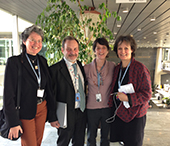 IBFAN and WHOFrom left to right
Lida Lhotska, IBFAN Regional Coordinator for Europe,
Dr Francesco Branca, Director, WHO Department for Nutrition and Health Development
Dr Elizabeth Mason, Director, WHO Department of Maternal, Newborn, Child and Adolescent Health
Patti Rundall, Co-Chair, IBFAN’s Global Council.
WHO's EXECUTIVE BOARD (EB) meeting (EB134) in Geneva began on 20th January and ended on the 25th. Conflicts of Interest, WHO's interactions with 'Non State Actors' have been hot topics. The EB decided to refuse ISDI (the baby feeding industry) official status but accepted IBFAN and GAIN. CLICK HERE
Conflicts of interest at work
15 January, 2014 - 14:53 — PattiThis story from Australia illustrates the pickle that some organisations can get into when they forget to check sponsors for conflicts of interest.
Media stories: Abbott in court, Sancor donations in China
9 January, 2014 - 19:49 — PattiJanuary 05, 2014
Jury to decide if baby formula caused Sioux City girl's brain damage Sioux City Journal.com CLICK HERE
CCTV news report from China: Corrupt hospitals stop breastfeeding
2 January, 2014 - 23:13 — Patti16th September 2013
CLICK HERE for a report on DUMEX/Danonein China
http://english.cntv.cn/program/china24/20130916/104588.shtml
- Login to post comments
Organizations denounce Nestlé’s new human rights impact assessment as a public relations stunt
19 December, 2013 - 23:07 — PattiFor Immediate Release December 19, 2013
Organizations denounce Nestlé’s new human rights impact assessment as a public relations stunt
12 Mandela Quotes That Won't Be In the Corporate Media Obituaries
8 December, 2013 - 17:38 — Patti12 Mandela Quotes That Won't Be In the Corporate Media Obituaries
SUN and Conflicts of Interest
6 December, 2013 - 11:05 — PattiSUN and Conflicts of Interest:
IBFAN is concerned about the non-transparent process (discussions under Chatham House Rules) chosen by SUN to address conflicts of interest. This process has been led by the Global Social Observatory (GSO), a Geneva-based think tank funded by the GATES Foundation.
Consultation on Goats' milk protein in infant formula
5 December, 2013 - 21:10 — PattiBaby Milk Ation comments on the Consultation on goats milk formulas
CLICK HERE for consultation papers
If you agree please use our comments to send a submission to:
parnutnotification@dh.gsi.gov.uk
DEADLINE for ENGLAND 6th December
URGENT: Sign this letter to oppose new rules that unfairly protect corporations.
4 December, 2013 - 15:23 — PattiIBFAN and many other organisations are becoming increasingly worried about the many trade deals now being struck - more often than not in the shadows - that seem to protect the interests of corporations at the expense of the poor.
Below is a letter that you can sign onto - as a quick way to register your concern.
Breastfeeding, stunting in EU and WHO Action Plans
3 December, 2013 - 15:23 — PattiThree important documents are under discussion now:
1 EU Action Plan to Reduce the Number of stunted children by 7 million by 2025
2 Draft EU Action Plan on Childhood Obesity
3 DRAFT WHO European Region Food and Nutrition Action Plan 2014 – 2020
Philippines Typhoon - Protecting infant health through breastfeeding.
29 November, 2013 - 19:07 — PattiTo understand the complexity of the situation and the pressures on those trying to protect infant health - read this first hand account by VELVET C. ESCARIO-ROXAS
You can see a picture of Velvet campaigning about BPA on the IBFAN website HERE
CLICK here for an INQUIRER NEWS STORY
SUN Business Network Announces New Members
27 November, 2013 - 15:00 — PattiSUN Business Network Announces New Members
New Soda Tax Makes Mexico a Leading Guardian of Public Health
26 November, 2013 - 20:30 — Pattihttp://www.huffingtonpost.com/larry/new-soda-tax-makes-mexico_b_4325724.html
New Soda Tax Makes Mexico a Leading Guardian of Public Health
This month the new government of Mexico made history. In the country that consumes more soda per capita than any in the world, where the former president had been the top executive for Coca-Cola, the national Congress struck a blow for public health by passing a one-peso-per-liter tax on soda and an 8 percent tax on junk food. We in the U.S. can learn a lot from our neighbor to the south--as well as from countries including Finland, Hungary and France that have passed similar measures. Even England's Conservative Party-led government is considering such a tax.
Urgent UN appeal NOT to send formula donations to Typhoon victims
21 November, 2013 - 18:40 — PattiSUPER TYPHOON YOLANDA: BREASTFFEDING SAVES LIVES!
The Nutrition Cluster joint statement on appropriate infant and young child feeding in the current emergency, and caution about unnecessary use of milk products.
Letters to the Lancet, the Editor's tweets and more
21 November, 2013 - 16:46 — PattiRead on for our letter to the Lancet Series on Maternal and Child Nutrition about the fact that two of the authors are members of Nestlé's Creating Shared Value Committee. Such roles could, depending on the circumstance, result in exclusion from European Food Safety Authority Working Groups.
Richard Horton, @richardhorton1 the Editor of the Lancet has since Tweeted the following questions:
Can anyone out there give me evidence about Nestlé's negative influences in health? Opinions are strong, and that's fine, but I need facts.
then later: What about Danone: are they the acceptable face of commercial influence in health? Or not? I just don't know
The power of big food: a few corporate conglomerates shape the way you live your life. How do we resist?
Follow the Twitter correspondence including from Prof Anthony Costello:
"Maybe one way to resist big food is not to have members of Nestle's advisory board directing the Lancet Nutrition Series" - and "Former head UNICEF nutrition asks why Lancet lead authors on nutrition series served on Nestlé Advisory Committe"
Our responses suggesting that he look at hard, on the ground evidence about Nestle or Danone - rather than what they say - have not been acknowledged. The suggestion from Gary Darmstadt of the Gates Foundation to look at FTSE4Good and ATNI (the two industry whitewashes ) was warmly welcomed. Interesting.
Comments on Foods for Special Medical Purposes (FSMPs) for infants and pesticides
14 November, 2013 - 16:39 — PattiComments by IBFAN, Baby Milk Action and the Baby Feeding Law Group
Tomorrow: 15th November 2013 Member States Experts meeting on Foods for Special Medical Purposes (FSMPs) for infants and pesticides in food for infants and young children
CLICK HERE for background papers
CLICK HERE for Commission FSMP paper
CLICK HERE for Commission Pesticides Paper
URGENT: IBFAN comments on global coordination mechanism on NCDs
30 October, 2013 - 09:13 — PattiCLICK Here for a PDF of IBFAN's comments (text below)
NEW Paper! NGO concerns about WHO’s consultation on engagement with non-State actors
29 October, 2013 - 05:15 — PattiNEW PAPER on NGO concerns about WHO’s consultation on engagement with non-State actors CLICK HERE
PLEASE read and support if you agree.
When: 17–18 October 2013, 10:00–13:00 and 15:00–18:00
Where: Executive Board room, WHO Headquarters
’Growing-up’ formula: No additional value to a balanced diet, says EFSA
25 October, 2013 - 08:50 — Patti
Mexico moves closer to a soda tax
18 October, 2013 - 21:48 — Patti
Last night, the Chamber of Deputies, Mexico's lower house of Congress, approved a 1 peso per liter tax on SSBs (10%)
310 in favor, 166 against, 5 abstentions, 19 absent.
Next up, the Senate! (which must vote on the fiscal reform package October 21-31)
CLICK here for background to the Crusade Against Hunger story.
Click here for El Poder del Consumidor - the fantastic consumer group we have been working with to protect child health.
- Login to post comments
WHO corrects its country implementation report.
16 October, 2013 - 13:51 — Patti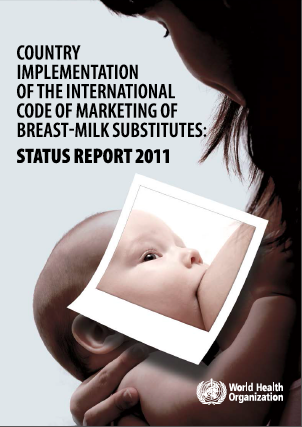 WHO Country Code reportWHO has now corrrected its report on Country Implementation of the International Code of Marketing of Breast-milk Substitutes - Status Report 2011.(1)
GSK pushes Junior Horlicks at 'Toddlers' in India
16 October, 2013 - 11:30 — Patti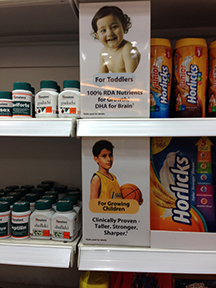 GSK Junior Horlicks promotion in IndiaSTOP PRESS: December 2013: Advertising Standards Council of India (ASCI) upheld a complaint against claims in GSK's print advertisement of Junior Horlicks, that ‘added supplement contents like DHA and CHOLINE in the product that are important for child's brain development’, ‘Competent and reliable scientific evidence’ (CRSE)’, ‘supplements containing omega-3 FA like DHA.’
http://www.ascionline.org/images/pdf/asci-ccc-sep-2013.pdf
Coming back through Delhi airport this weekend I noticed this promotion for GSK's Junior Horlicks in the Guardian Pharmacy claiming: "100% RDA Nutrients for Growth, DHA for Brain."
I thought all promotion of foods for children under 2 years is stricly banned in India. Since GSK has now joined GAIN perhaps we can expect more of this.
One good piece of news about GSK however - it has sold Ribena and Lucozade.
http://www.bbc.co.uk/news/business-24013720
- Login to post comments
Abbott promotion in Grenada
18 September, 2013 - 07:22 — PattiCLICK HERE for Mike Brady's Blog about the awful sponsorship at the International Conference on Nutrition in Grenada Spain.
CICK here for the sponsors
Here's an example of one of the displays!
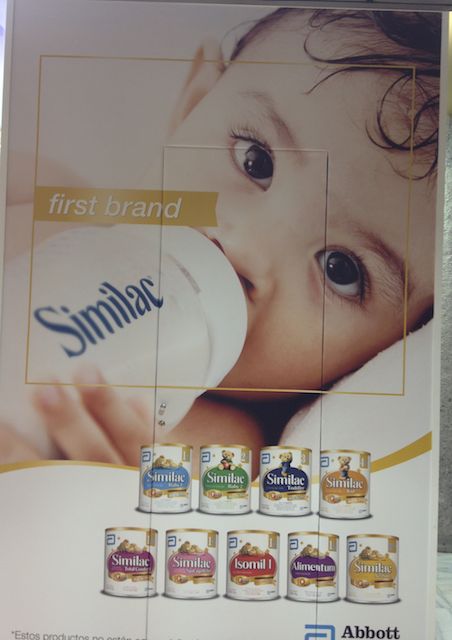 Abbott promotion in Grenada
- Login to post comments
Baby food from shops half as nutritious as homemade meals, study finds
11 September, 2013 - 15:30 — Patti
Links on conflicts of interest
10 September, 2013 - 14:03 — Anonymous
Here are some Links to background papers that may be useful:
Conflict of Interests: Maternal and child Nutrition Big Food and Big Science
9 September, 2013 - 08:19 — Patti
Codex: IBFAN and IACFO Comments on the India proposal for foods for Underweight children.
26 July, 2013 - 06:59 — PattiProposal for a Part B in the Standard for Processed Cereal-Based Foods for Infants and Young Children (Codex Stan 074-1981, Rev – I 2006)
Report on the Post 2015 Development Goals
16 July, 2013 - 16:32 — PattiThe Secretary General's High Level Panel of Eminent Persons on the Post 2015 Development Goals, has released its Report with recommendations on the Post MDGs development goals for the next 15 years
Guidance on commercial Sponsorship - Nestle sneaks in
10 July, 2013 - 09:58 — Patti
With all the dodgy sponsorship of conferences going on people may welcome the IBFAN and Baby Feeding law group guidelines. (Page down for links)
Here I am (9.7.13) with Mike Brady outside the Royal College of Physicians where Nestlé had booked an event targeting health workers under a different name. The RCP say they would not have accepted the booking had they known. See Mike's campaign blog for more details and news, including the cancelling of one in Birmingham tomorrow.
Letter from a paediatrician to the Chilean Paediatrics Association president
2 July, 2013 - 11:11 — PattiCLICK HERE for PDF of a really good letter about Danone sponsorship from Dra. Cecilia Castillo L. in Chile
At last - some accurate reporting on Venezuela
22 June, 2013 - 09:55 — PattiCLICK HERE for a very good article exposing the way that corproate media has distorted the moves to strengthen infant and young child health protection in Venezuela.
http://venezuelanalysis.com/analysis/9740
Cochrane finds food as good as commercial Ready-to-use products
20 June, 2013 - 05:33 — PattiCLICK HERE FOR IBFAN STATEMENT ON COCHRANE
Lax marketing regulations contribute to obesity crisis in children
19 June, 2013 - 13:23 — PattiCLICK HERE for WHO Euro's new report
Lax marketing regulations contribute to obesity crisis in children
Copenhagen, 18 June 2013
WHO DG, Dr Margaret Chan, exposes industry tactics
12 June, 2013 - 07:24 — PattiCLICK HERE or page down to read the excellent speech made by the Dr Margaret Chan, WHO's Director-General at the 8th Global Conference on Health Promotion Helsinki, Finland 10 June 2013:
"Efforts to prevent noncommunicable diseases go against the business interests of powerful economic operators. In my view, this is one of the biggest challenges facing health promotion. As the new publication makes clear, it is not just Big Tobacco anymore. Public health must also contend with Big Food, Big Soda, and Big Alcohol. All of these industries fear regulation, and protect themselves by using the same tactics. Research has documented these tactics well. They include front groups, lobbies, promises of self-regulation, lawsuits, and industry-funded research that confuses the evidence and keeps the public in doubt. In the view of WHO, the formulation of health policies must be protected from distortion by commercial or vested interests."
European Parliament to vote on new regulations on baby food marketing
10 June, 2013 - 17:18 — Patti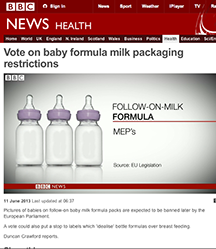 BBCEuropean Parliament to vote New regulations on baby food marketing
If Campaign: don't forget strong legislation controlling baby food and junk food marketing.
9 June, 2013 - 16:56 — Patti
Lancet series on Maternal and Child Nutrition
6 June, 2013 - 18:06 — PattiUK Government raises concerns about Probiotics
30 May, 2013 - 16:05 — PattiSee previous blog entry HERE
The EU Parliament's ENVI Committee yesterday voted unanimously for the new proposals for a Regulation on food intended for infants and young children, food for special medical purposes. This will now go forward for the final vote in the full EU Parliament in Strasbourg in June.
One of the things we have been lobbying for in these proposals is the issue of 'optional ingredients' and the pre-authorisation of all ingredients used in baby formulas and foods, so we are pleased that once this regulation is adopted these issues can be considered in the new delegated acts. Whatever happens, there will be more oversight from Parliament on all new ingredients.
Kellogg To Pay $4 Million Over Frosted Mini-Wheats Ad That Claimed Cereal Improved Kids' Attentiveness
30 May, 2013 - 13:35 — Patti
Conflicts of Interest discussed at the World Health Assembly and EB 133 -news and useful links
21 May, 2013 - 15:03 — Patti
Ronald McDonald and Tony the Tiger look for new jobs - Kellogs forced to compensate children
18 May, 2013 - 07:54 — Patti Marketing junkfood to children : two familiar figures visit the World Health Assembly - Ronald McDonald and Tony the Tiger look for new jobs handing out their CVs to delegates attending the World Health Assembly. 20th May
Here I am being refused entry into the UN, apparently because I failed to meet the UN dress code. Later in the week I was given a much better reason for the refusal - that it was deceptive. Perhaps the corporations that use these disguises to befriend children could think about that!
CLICK HERE for PDF of Consumers International Press release
CLICK HERE for World Public Health Nutrition Weblink.
CLICK HERE: Kelloggs has to payout. 28th May: www.cerealsettlement.com
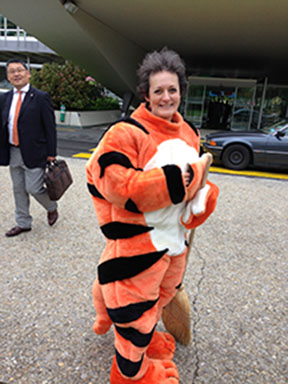 Patti as TonyHere I am outside the headquarters of the World Health Organization taking a breather.
OPEN Letter to President Nieto (plus LLL Mexico Petition and Letter to Secretary Robles)
9 May, 2013 - 19:29 — Patti
Stop Nestle patenting fennel flower properties, Peter Brabeck says water is not a public right
21 April, 2013 - 09:44 — Patti
IBFAN Comments on 4th Draft of WHO's Plan of Action on NCDs
30 March, 2013 - 08:32 — PattiFriday 29 March 2013 was the last day for public comments on the 4th draft of WHO's Global Action Plan for the prevention and Control of NCDs (2013-2020)
New comments on WHO’s engagement with non-State actors
25 March, 2013 - 10:28 — PattiToday is the last day for comments on the Public web consultation on WHO’s engagement with non-State actors.
New IBFAN Comments on WHO's Plan of Action on NCDs and Conflicts of interest
8 March, 2013 - 15:35 — Patti
Call for input on UN Forum On Business And Human Rights Deadline 12 April 2013.
7 March, 2013 - 19:41 — PattiUnited Nations Forum on Business and Human Rights States, business, civil society and other stakeholders can submit suggestions for the 2013 United Nations Forum on Business and Human Rights.
Submissions may be sent to forumbhr@ohchr.org by 12 April 2013.
Nestle's CEO to speak at the Guildhall in London Monday 25th February
24 February, 2013 - 15:56 — Patti
Big Business undermines breastfeeding campaign as mothers turn to milk formula
16 February, 2013 - 22:31 — PattiBelow is an excerpt from an excellent article in Today's Guardian about baby food companies in Indonesia:
IBFAN's rebuttal of GAIN’s comment on our Press Release on the WHO Decision:
7 February, 2013 - 21:22 — Patti
GAIN's application deferred in the COI debate at the WHO's Executive Board meeting
18 January, 2013 - 12:26 — Patti
LAST DAY OF Consultation on new MDGs - new deadline 10th January
9 January, 2013 - 20:15 — Patti
If you agree that breastfeeding should be specifically mentioned in the next Millennium Development Goals please make a submission - however short - to an online consultation that ends 10th January. Follow this link Contributions can be posted on the consultation website(www.fao.org/fsnforum/post-2015) or sent to fsn-moderator@fao.org and are welcome in English, French, Spanish, Arabic, Russian and Chinese.
IBFAN's submission is HERE
Help stop unethical research in Indonesia
3 January, 2013 - 07:28 — PattiSTOP PRESS: We understand that this research is to stop. Thanks to all those who supported this campaign
Please help stop the industry funded research about to start in Indonesia entitled "Effect in Using Formula Composed with Cow's Milk Fat, Enriched with Mixed Fats & Added Fosfolipid on Duration & Infection in Babies' Digestive and Respiratory System"
Click HERE
The protection of infant and young child health in Brazil
21 December, 2012 - 12:16 — PattiIBFAN has written to the Her Excellency, Dilma Roussef, DD President of Brazil, about the Regulation of Law 11265/2006 which protects infants from the unethical commercial promotion of products that undermine breastfeeding practices.
The link to one of the letters is HERE
The interesting article in the Guardian about the tour of the Nestle ship is HERE
Rapid Responses on the BMJ: Lack of transparency in the Business of malnutrition
18 December, 2012 - 00:02 — PattiJoin the ongoing discussion in the BMJ about Veena Rao's personal opinion piece entitled, "Law on infant foods inhibits the marketing of complementary foods for infants, furthering undernutrition in India" click HERE Following our complaint the BMJ has published the following correction: "In this online Personal View (BMJ 2012;345:e8131, doi:10.1136/bmj.e8131) the author, Veena Rao, did not declare any competing interests. She has now told us that she has been “a member of the Advisory Board on the Britannia Nutrition Foundation (a non-profit trust) since 2009.” The website of the foundation is at www.britannia.co.in/bnf/index.html. Ms Rao has submitted a further comment but fails to mention that Britannia Nutrition Foundation is funded by Brittania Industries Ltd.
IBFAN Comments on SUN
15 December, 2012 - 08:15 — PattiIBFAN's Discussion Paper on the Scaling Up Nutrition (SUN) initiative - outlining our concerns about the role of businesses and why we cannot be part of SUN has been posted onto the SUN wesbite here just above a link to the launch of the SUN Business network
Cross Branding - how this can harm infant and young child health
5 December, 2012 - 11:06 — PattiCross Branding - how this can harm infant and young child health
A BMJ study looked at the impact of idealised images and cross branding (in this case Nestlé's Mother and Baby bear logo on coffee creamer ) in LAOS one of the world's poorest countries. It s relevant and pertinent to the ongoing discussions in Codex.
34th Codex Nutrition meeting Germany
3 December, 2012 - 06:33 — PattiImportant development in EU rules on baby food marketing
28 November, 2012 - 06:55 — PattiI have been attending an EU Food Law meeting this week on The Revision of the PARNUTs Directive - it was attended by all the major companies.
The UK Infant Feeding Survey published
25 November, 2012 - 08:48 — PattiThe Infant Feeding Survey (IFS) has been conducted every five years since 1975. The 2010 IFS was the eighth national survey of infant feeding practices to be conducted. The main aim of the survey was to provide estimates on the incidence, prevalence, and duration of breastfeeding and other feeding practices adopted by mothers in the first eight to ten months after their baby was born.
- Login to post comments
WHO clarification on industry funding
14 November, 2012 - 14:06 — PattiTODAY: Opportunity to strengthen EU legislation on foods for infants and young children
13 November, 2012 - 17:47 — Patti
IBFAN recommendations for strengthening the Proposal for a regulation of the European Parliament and of the Council on food intended for infants and young children and on food for special medical purposes
President Obama and the breastfed baby
10 November, 2012 - 23:08 — PattiObama and babyNice story sent by Siti Norjinah Moin, Founder of the Malaysian Breastfeeding Association. Director of Breastfeeding Information Bureau (BIB Malaysia).
World Nutrition Rio2012
1 November, 2012 - 20:36 — PattiI gave four presentations at this marvellous nutrition conference - which was the first of its kind to be free of corporate funding - and it showed.
World Public Health nutrition
23 October, 2012 - 09:37 — PattiDo remember to check out the rather wonderful articles on the World Public Health Nutrition website. http://www.wphna.org
New moves in the US for litigation on false labelling of junk foods
20 October, 2012 - 08:00 — Patti

UNICEF UK report on the costs of not breastfeeding
19 October, 2012 - 21:14 — Patti‘Preventing disease and saving resources: the potential contribution of increasing breastfeeding rates in the UK’
Reuters Report: Food, beverage industry pays for seat at health-policy table - Reuters Report
19 October, 2012 - 17:12 — PattiFood, beverage industry pays for seat at health-policy table
Click here for the Reuters report on WHO that has generated a flurry of responses - page down
Fringe meetings at the Conservative Party Conference
7 October, 2012 - 19:26 — Patti- Login to post comments
Fringe meetings at the Labour Party Conference
1 October, 2012 - 08:07 — PattiFringe meetings at the Labour Party Conference in Manchester 1st - 3rd October
- Login to post comments
Letter to UN Secretary General re: NGO Concerns about the proposal for a Global Coordination Platform on NCDs
27 September, 2012 - 13:29 — Patti
Responses to WHO Consultation on ACTION PLAN 2012-2020
26 September, 2012 - 08:13 — PattiResponses to WHO consultation: Updated Action Plan for the Global Strategy for the Prevention and Control of Non-communicable Diseases - 2013-2020
IBFAN's response is here:
The World Cancer Research Fund response is here:
- Login to post comments
WHY IBFAN HAS NOT SIGNED ON CIVIL SOCIETY PLEDGE OF ‘A RENEWED PROMISE’ INITIATIVE
26 September, 2012 - 08:04 — Patti
WHY IBFAN HAS NOT SIGNED ON CIVIL SOCIETY PLEDGE OF ‘A RENEWED PROMISE’ INITIATIVE
- Login to post comments
Tackling hunger - don't partner food giants, or forget breastfeeding and the underlying causes
10 August, 2012 - 08:53 — PattiSunday 12th August 2012 - World Leader Summit on hunger - hosted by David Cameron
Prof Zef Ebrahim Memorial Lecture
1 August, 2012 - 13:54 — Patti
'Challenges for Mother and Child Health: perspectives from Southern Africa' ,
All are welcome to the Prof Zef Ebrahim Memorial Lecture on Wednesday 3rd October 2012 at 12 noon in the Kennedy Lecture Theatre, Institute of Child Health, 30 Guilford Street, London. The talk will be given in Zef's honour by one of his ex-students, Dr Felicitas Zawairi, now WHO Representative in Malawi.
Zef work has been of critical importance to IBFAN and Baby Milk Action since the 70s and we miss him terribly. (More to follow)
For Zef's Obituary in the Guardian see:
http://www.guardian.co.uk/global-development/2012/may/24/zef-ebrahim-obituary
- Login to post comments
One time chance to stop misleading information to parents: Vote in EU Parliament on 14th June
5 June, 2012 - 23:55 — Patti
National Guardswomen breastfeeding controversy
3 June, 2012 - 07:40 — PattiWHA Resolution on Infant and Young Child Feeding tackles conflicts of interest
25 May, 2012 - 16:19 — WebmasterThe 65th World Health Assembly passed an important Resolution on Maternal, infant and young child nutrition.
For Press release see: http://info.babymilkaction.org/IYCNResolution2012
The proposed text is attached as a pdf. This was adopted today.
For further details contact Patti Rundall, Baby Milk Action Policy Director on: 07786 523493
- Login to post comments
PAHO Expert recommendations on Non-Alcoholic Beverages to Children in the Americas
18 May, 2012 - 20:01 — Patti
Nestlé and Food Safety: discrepancy between the company’s public statements and actual practices
16 May, 2012 - 17:35 — PattiReuters report on Food lobbying: How Washington went soft on childhood obesity
15 May, 2012 - 09:12 — Patti
How Washington went soft on childhood obesity
http://graphics.thomsonreuters.com/12/04/Food_lobby.pdf
- Login to post comments
Nestle signs three year deal with the International Diabetes Federation
14 May, 2012 - 22:12 — Patti
Media watch: Time Magazine
11 May, 2012 - 12:37 — Patti
This front cover of TIME magazine has generated huge debate....
New push to stop free infant formula at hospitals
A national campaign against obesity spreads to South Florida in an effort to stop hospitals from giving free formula to new moms.....
http://www.miamiherald.com/2012/06/23/2861471/new-push-to-stop-free-infant-formula.htmlm/2012/06/23/2861471/new-push-to-stop-free-infant-formula.html
such bad news for babies as Nestle buys Pfizer
23 April, 2012 - 08:11 — Pattisee our press release on this worrying news.
http://info.babymilkaction.org/pressrelease/pressrelease23apr12
- Login to post comments
Lord Ashley - strong supporter of the Baby Milk Campaign dies
21 April, 2012 - 21:58 — Patti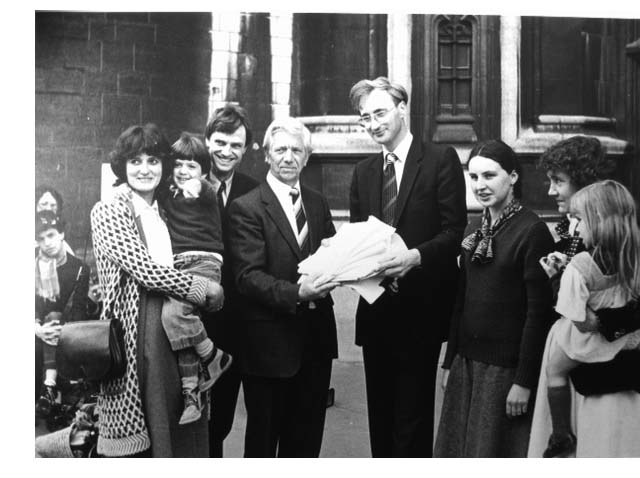 Jack Ashley presents a petition to Sir George Young 1981
New "All about IBFAN" video
17 April, 2012 - 19:07 — PattiHere are some links to a brand new video “All about IBFAN” on youtube
http://www.youtube.com/watch?v=JjrI2TTHWpk&feature=youtu.be
WHO Consultations on the control of NCDs: Monitoring, Targets and Partnerships Deadline extended to 19th April
29 March, 2012 - 20:51 — Patti
Consultation on CRC Child Rights and Business. IBFAN comment on CRBPI
22 March, 2012 - 10:50 — Patti
IBFAN concerns about FTSE4Good
11 March, 2012 - 18:03 — WebmasterClick here to download IBFAN's briefing on FTSE4Good as at 9 March 2012.
Click here to download the annexes as a zip file.
Also see Baby Milk Action's earlier briefing.
- Login to post comments
Special Rapporteur on the Right to Food speaks about breastfeeding, the Code and monitoring the private sector
6 March, 2012 - 20:23 — Patti
IBFAN comments on WHO Proposed Global Targets for maternal, infant and young child nutrition
24 February, 2012 - 18:08 — Patti
EU Platform on Diet and Physical Activity 9th February
9 February, 2012 - 09:34 — PattiConflicts of Interest Coalition statement - media and new endorsers
3 February, 2012 - 20:17 — PattiProduct placement of baby milk in TV programmes is banned
15 December, 2011 - 16:19 — WebmasterDid you know that it is against the rules for television programmes to accept payment for showing baby milk in television programmes?
Follow-on milks and baby food claims to be debated at Codex meeting in Germany
13 November, 2011 - 20:46 — PattiThe Business of malnutrition: breaking down trade rules to profit from the poor
Click here for the press release following this meeting:
http://info.babymilkaction.org/pressrelease/pressrelease24nov110
Day 1 - Saturday 12 November
I am attending the Codex meeting in Bad Soden, Frankfurt this week, wearing the IACFO hat, along with IBFAN colleagues from Swaziland, Canada and Luxembourg. See below for our comments on the agenda items.
WHO Reform highlights the importance of protecting WHO's independence and integrity.
7 November, 2011 - 12:37 — Patti
German Safety Institute says Toddler milk drinks are not better than cow milk
26 October, 2011 - 12:06 — Patti
IBFAN comments on EFSA consultative workshop on Independence and Scientific Decision-Making Processes
20 October, 2011 - 15:01 — Patti
Exposing the risks of food industry involvement in education
14 October, 2011 - 08:40 — PattiAt the last meeting of the European Platform for Diet and Physical Activity, on the 6th October in Brussels, Mars, Media Smart and others gave presentations about their nutrition and media education projects.
Commercial involvement in UK Start4Life: Breastfeeding Manifesto Coalition & Baby Feeding Law Group comments
13 October, 2011 - 13:57 — Patti
Urgent call - help improve the safety of ingredients. Call for pre-authorisation
30 September, 2011 - 14:20 — PattiUrgent call for pre-authorisation of baby food ingredients
Comments on UN Political Declaration on Non-Communicable Diseases
26 August, 2011 - 14:57 — PattiIBFAN Comments on UN Political Declaration on Non-communicable Diseases
Throwing oneself “into the lions’ den”
29 July, 2011 - 23:31 — PattiArticle in La Liberté and Le Courier about out the Nestle Shareholder meetings - 29.7.11 - in French
Here is an English translation of the text:
OPEN LETTER re: Civil Society concerns about the Children's Rights and Business Principles Initiative.
15 July, 2011 - 15:39 — PattiArticles about Partnerships and Voluntary controls
6 July, 2011 - 21:45 — PattiVoluntary controls fail to reduce harmful advertising
Call for endorsement of IBFAN’s comments on Children's Rights and Business Principles Initiative (CRBPI)
5 July, 2011 - 16:29 — PattiCall for endorsement of IBFAN’s comments on Children's Rights and Business Principles Initiative (CRBPI)
Please send an email by 14th July to: prundall@babymilkaction.org if your organisation can endorse these comments which will be submitted before the consultation deadline: 15th July.
Comments on the concept papers for WHO's Reform Process
30 June, 2011 - 16:11 — PattiWHA 64 Consumers International/ IBFAN Statement on draft HIV Strategy
30 May, 2011 - 15:55 — PattiWHA 64: Consumers International/IBFAN statement on Infant and Young Child Nutrition.
24 May, 2011 - 17:06 — Patti
WHA 64 Consumers International/ IBFAN Statement on Prevention and Control of non-communicable diseases (NCDs)
21 May, 2011 - 12:39 — PattiWHA 64: WHO's reforms for a healthy future: Statement by Corporate Accountability International/IBFAN
19 May, 2011 - 10:09 — Patti
WHA 64: IBFAN Position on WHO's Future of Financing and the World Health Forum
15 May, 2011 - 19:05 — Patti
BFLG /IBFAN calls on the European Commission to reject the HIPP ALA and Thiamin claim.
11 May, 2011 - 16:59 — Patti

Tackling Obesity: How Companies Use Education to Build Trust.
25 April, 2011 - 09:33 — PattiSEE ATTACHED BRIEFING
See this awful paper from the Scottish Government, Principles for food companies working with schools in Scotland which seems to contain absolutely no principles:
Kinder Chocolate promotion in the EU parliament
- Login to post comments
UNICEF expresses its support for the Resolution opposing the health claim
29 March, 2011 - 22:25 — PattiDr Nicholas Alipui, Director of Programme at UNICEF HQ in New york has responded to a request from an MEP for an opinion on the DHA claim.
Companies stop using DHA claims in the USA. California WIC write to MEPs
27 March, 2011 - 13:49 — Patti
Letter to MEPs from Sri Lanka about the DHA claim
15 March, 2011 - 11:52 — Patti"a butterfly flapping it's wings in one area of the world, can cause a tornado in another part of the world"
US FDA survey of 10,000 women's understanding of health claims
10 March, 2011 - 06:59 — PattiHere is a really important development
European Parliament Resolution refusing the authorisation of DHA health claim and industry comment
28 February, 2011 - 12:31 — PattiPlease see all the links to the relevant papers here:
http://info.babymilkaction.org/news/policyblog/dhabriefing
The whole Resolution is attached. The key paragraphs (J-S and 1-3) are on pages 4 and 5:
Abbott pays bloggers for positive reviews of its Similac Iphone app
24 February, 2011 - 22:52 — Patti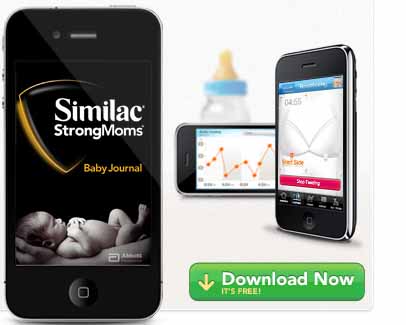 Similac Iphone app
BBC Politics Show on DHA Claim
Patti Rundall, Baby Milk Action Policy Director, on the BBC Politics Show East Midlands on 13 February 2010.
Send a message to Members of the European Parliament by going to:
http://info.babymilkaction.org/cem/cemfeb11
Indian Alliance Against Conflict of Interest writes to Minister about Nestlé.
6 February, 2011 - 09:08 — Patti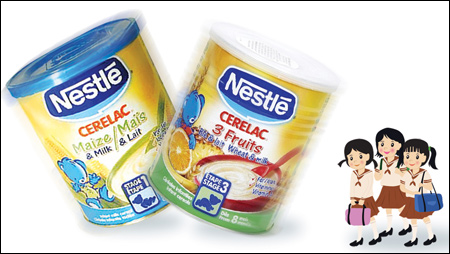 Cerelac in India Feb 2011"The secret of success is sincerity. Once you can fake that you've got it made" Jean Giraudoux (1882-1944).
DHA briefing - redirect
2 February, 2011 - 17:17 — WebmasterPlease click here.
- Login to post comments
EURO-MPS BATTLE TO BLOCK BABY MILK HEALTH CLAIM
28 January, 2011 - 14:26 — PattiNews from the
European Parliamentary Labour Party
Press Release
27 January 2011
For Immediate Release
EURO-MPS BATTLE TO BLOCK BABY MILK HEALTH CLAIM
Redirect
26 January, 2011 - 16:10 — WebmasterPlease go to: http://info.babymilkaction.org/news/campaignblog260111
- Login to post comments
Consumers International/ IBFAN speeches, WHO Executive Board Meeting
21 January, 2011 - 14:42 — Patti
Consumers International/IBFAN speeches at the WHO Executive Board Meeting, Geneva. January 2011, WHO Geneva
How media reporting can derail health policy
18 January, 2011 - 19:16 — Patti
The debate about the value of the BMJ comment piece rages on, with misleading stories and headlines falsely implying that breastfeeding is a risk to health and that the UK guidance is a rigid dictate to mothers forbidding any food other than breastmilk until the clock strikes midnight at the end of the 6th month. Since some of the media are also questioning whether the links between the authors and the baby food industry are relevant, I thought it might be helpful to explain our concerns about the paper, its timing and the authors' knowledge of the risks of media reporting.
BFLG response to Consultation on Bisphenol A in feeding bottles
14 January, 2011 - 15:24 — PattiConsultation on Bisphenol A: The Plastic Materials and Articles in Contact with Food (Eng)
WHO breastfeeding recommendations under attack from industry-funded scientists.
14 January, 2011 - 11:57 — Pattisee also new Policy Blog: http://info.babymilkaction.org/node/326
WHO breastfeeding recommendations under attack from industry-funded scientists
Press release 14 January 2011
The BBC, the Guardian, The Times, The Sun and other media are carrying stories - about a comment piece from four authors published in the British Medical Journal today challenging World Health Organisation (WHO) recommendation that breastfeeding is exclusive for 6 months (no other foods or drinks introduced). The media coverage implies that the challenge is based on new evidence. In fact this is not a new scientific study nor a systematic review, but the authors review of selected past research, published in the 'Analysis' section of the BMJ.
New Zealand ASA upholds complaint against Wyeth for S26 Lutien eye claim
6 December, 2010 - 22:30 — PattiNew Zealand ASA upholds complaint against Wyeth for S26 Lutien eye claim
Two magazine advertisements published in Littles were both very similar and featured the headline piece which read:
“SEE THE WORLD THROUGH THEIR EYES”
EU to decide on DHA claims
29 November, 2010 - 13:40 — PattiSTOP PRESS: The EU Committee that met on the 6th December APPROVED the claim that DHA improves eyesight for use on follow-on milks and baby foods, Members of the European Parliament and the European Council now have 3 months to comment.
Please contact your local MEP and asked them to stop this claim being approved.
EU deadline for DHA, ALA and ARA claims
The European Food Safety Authority (EFSA) continues to plough through the hundreds of dossiers supplied by food companies who wish to make claims on foods (see UDs 41 & 42). We focus on children’s food and formula claims which fall under Article 14 of the European Nutrition and Health Claims Regulations (1924/2006).
Baby Feeding law Group writes to Rt Hon Andrew Lansley, CBE, Secretary of State for Health
12 November, 2010 - 17:35 — Patti
Commercial involvement in UK Start4Life: Baby Milk Action Comments
19 October, 2010 - 07:09 — PattiBaby Milk Action response to Department of Health Questions regarding commercial involvement in Start 4 Life October 2010
What would your criteria be for supporting the inclusion of an organisation as a Start4Life partner?
In addition to the submission made on behalf of the Baby Feeding Law Group and the Breastfeeding Manifesto Coalition Baby Milk Action would like to make some additional comments regarding the consultation about Private Sector involvement with Start for Life.
The questions posed need to be rephrased. Baby Milk Action is not comfortable with being seen as supporting partnership with any for-profit company on any government health education scheme, especially on Start4Life. Our position has, from the start, been that the involvement of commercial companies in education schemes risks undue commercial influence of the messages being conveyed, increasing the likelihood that parents receive conflicting messages which are known to undermine the DH public health line. We cannot stress enough the importance of all governments taking seriously their responsibilities and obligations under the Global Strategy for Infant and Young Child Nutrition to provide truly objective, evidence-based information and support to parents.
Article in Archives of Diseases in Childhood
30 July, 2010 - 17:28 — PattiArch Dis Child published online July 26, 2010 J S Forsyth
http://adc.bmj.com/content/early/2010/06/22/adc.2010.187294.full
International code of marketing of breast-milkand international governance --three decades later time for hostilities to be replaced by effective national substitutes
An article in the Archive of Diseases in Childhood by Prof Stewart Forsyth (who declares long-standing collaboration with the formula companies) portrays a harmful message about Baby Milk Action and other groups monitoring and campaigning to stop the harmful marketing of baby foods. Below are some comments about the article and the media coverage it is generating:
Letter to the US House of representatives about health claims and additives
13 July, 2010 - 20:44 — Patti
Response to DCSF Consultation on Impact of the Commercial World on Children's Wellbeing - A Call for Evidence
17 June, 2010 - 23:37 — Patti
Baby Milk Action response to the Department of Children Schools and Families consultation: Assessing the Impact of the Commercial World on Children's Wellbeing - A Call for Evidence July 2008
Baby Feeding Law Group writes to Mead Johnson about Alactagrow promotion in the Philippines
16 June, 2010 - 09:46 — Patti
The Baby Feeding Law Group representing 24 leading health professional and lay organisations in the UK, including the Royal Colleges of Paediatrics, Nursing and Midwifery, has written to the US company Mead Johnson about its irresponsible promotion of Alactagrow in the Philippines.
Michael Gove's 'Dark Agenda'
27 May, 2010 - 11:45 — PattiOne aspect of the new Education Minister, Michael Gove's policy that hasn't been questioned is what he means when he will check whether parents who want to set up new schools have a "dark agenda."
Good that he promises not to allow extremist religious groups,' fake theories' and 'bogus science' - but what about the corporate agenda?
Nestle, the UN Global Compact and OECD Guidelines
21 May, 2010 - 13:16 — WebmasterWhat happened when Nestlé was reported for violating the UN Global Compact and OECD Guidelines for Multinational Enterprises?
Abstract
The UN Global Compact and the OECD Guidelines for Multinational Enterprises seek to improve compliance of businesses with human rights norms and other international standards. A coalition of organisations registered complaints in June 2009 regarding Nestlé S.A. to the Global Compact Office and the Swiss National Contact Point (NCP) for the OECD Guidelines. Both stressed they are responsible for voluntary initiatives and that they are only prepared to promote 'dialogue'. Although the UN Global Compact Office has powers to exclude companies, it stated: "Of course, abuses of the 10 Principles do occur; however we believe that such abuses only indicate that it is important for the company to remain in the Compact and learn from its mistakes." It is suggested that this international regulatory framework is both ineffective at holding corporations to account and is misused for public relations purposes. Alternatives are proposed.
Baroness Kinnock of Holyhead answers Lord Avebury's PQ on Nestle and UNHCR
2 May, 2010 - 14:33 — PattiQuestion tabled in the House of Lords by Lord Avebury, (Lib Dem Peer) 30th November 2009
To ask Her Majesty's Government whether they will discuss with the United Nations High Commissioner for Refugees the desirability of entering into a new partnership agreement with Nestlé, with reference to the International Code of Marketing of Breast-milk Substitutes and subsequent relevant World Health Assembly resolutions. [HL378]
The Minister of State, Foreign and Commonwealth Office (Baroness Kinnock of Holyhead): We fully support the principles of the International Code of Marketing of Breast-milk Substitutes and subsequent resolutions adopted by the World Health Assembly and are committed to the promotion and encouragement of breastfeeding for infants. We have spoken with the United Nations High Commissioner for Refugees and understand that they are in the process of considering their position.
6 Jan 2010 : Column WA99
- Login to post comments
US bans synthetic DHA ARA in organic formulas
30 April, 2010 - 16:18 — PattiUS bans DHA and ARA in organic formulas
Obama administration bans two additives used in organic baby food
By Kimberly Kindy Washington Post Staff Writer Wednesday, April 28, 2010
The Obama administration announced Tuesday that two synthetic additives will no longer be permitted in infant formula or baby foods certified as organic because the widely used ingredients have not received legal approval for use in organic products The additives -- omega-3 fatty acid DHA and omega-6 fatty acid ARA -- are present in 90 percent of organic infant formulas and are marketed as promoting brain and eye development in ways that mimic breast milk. The Washington Post reported last July that U.S. Department of Agriculture employees had concluded three years earlier that the fatty acids violated federal standards and should be banned from products carrying the federal organic label. Their findings were overruled by a USDA program manager who had been heavily lobbied by the formula industry.
Nestle challenged at its AGM 2010, Lausanne, Switzerland 15th April
16 April, 2010 - 17:54 — PattiBelow is my intervention at Nestlé's Shareholder meeting in April 2010 in Lausanne. I challenged the company about its failure to abide by marketing standards adopted by the World Health Assembly and about it health claims strategy which tells mothers in 120 countries that its baby milk will 'protect' their babies. At this AGM we were joined by Greenpeace activists who cut through the ceiling to challenge Nestle about its exploitation of palm oil.
In response to Greenpeace, Peter Brabeck, Nestlé's Chair and CEO said: 'Tying corporations up in regulatory straightjackets is unnecessary when companies such as Nestlé already have sound principles and core values.’
BREAKTHROUGH IN THE PHILIPPINES: BREASTFEEDING IN THE WORKPLACE IS A LAW
22 March, 2010 - 15:15 — PattiTackling Obesity: How Companies Use Education to Build Trust. Briefing
12 March, 2010 - 14:38 — Patti
Breastfeeding provides an ideal window of opportunity for obesity prevention and may help in the development of taste receptors and appetite control.
The US Centre for Disease Control and Prevention (CDC) considered that there are two potential, cost-effective interventions that can be put into place immediately to deal with the childhood obesity epidemic: decreased television viewing and breastfeeding promotion.
“Artificially fed infants consume 30,000 more calories than breastfed infants by 8 months of age” (equivalent to 120 chocolate bars - 4 a week). Student Study Guide for Breastfeeding and Human Lactation KG Auerbach, J Riordan - 1993
As pressure builds to stop junk food advertising to children, many companies are focussing attention on nutrition and health education in an attempt to re-establish themselves as producers of healthy food. By building public trust in this image they can divert attention from the continued aggressive marketing of unhealthy foods. The education materials and facilities that are produced as a result present an even more complex problem than straightforward advertising because they blur the boundaries between advertising, marketing and education.
Although individual employees often have philanthropic motives, corporations themselves have a fiduciary duty to their shareholders to maximise profits, so the deal will be done with multiple motives:
For example, companies will hope to:
- involve potential critics in partnerships and so discourage them from speaking out;
- discourage open debate about sponsors
- undermine the independence of monitoring schemes;
- use education facilities as a channel for commercial propaganda which undermines public health messages;
- project a healthy, responsible corporate image and so gain the trust of children, parents and teachers;
- distort the curriculum in favour of business interests - promoting a self regulation and partnership approach to marketing rather than regulation;
- use the ‘halo’ effect as evidence of Corporate Social Responsibility
- divert attention from/‘engineer consent’ for actions which are anti-social and which harm sustainable development, the environment and human survival.
..
- Login to post comments
Independent Review Panel reports Press release 11 March 2010
12 March, 2010 - 14:26 — PattiGovernment panel says there need to be 'steps taken' to address problems in enforcing baby milk marketing law. Campaigners welcome recommendation and call for UK law to be brought into line with international standards http://info.babymilkaction.org/pressrelease/pressrelease11mar10a
- Login to post comments
Publication of the Review of infant formula and follow-on formula controls
11 March, 2010 - 14:55 — PattiThe report of the Independent Review Panel has been published today (11th March) on the DH and FSA wesbites. The Minister for Public Health, Gillian Merron, will publish her response 'as soon as possible'.
Baby Milk Action and the Baby Feeding Law Group will publish a response ASAP also.
http://www.food.gov.uk/healthiereating/nutcomms/infformreview/
http://www.dh.gov.uk/en/Publicationsandstatistics/Publications/Publicati...
A summary of the responses can be found on this link:
US Developments: Kiran Saluja of WIC to House of Representatives, papers about additives.
9 March, 2010 - 21:21 — PattiImproving Child Nutrition Programs Will Help More Children Succeed, Witnesses Tell House Committee
http://edlabor.house.gov/newsroom/2010/03/improving-child-nutrition-prog.shtml
Questions put to the Food Standards Agency (FSA) Board November 2009
On behalf of the Baby Feeding Law Group I ask the FSA Board about:
- the narrow remit of the Independent Review Panel and suggest that it has been a waste of public money;
- the conflicts of interest in the European Food Safety Authority (EFSA) and the impact this may have on the report of the working group on complementary feeding
- concerns about the EFSA decisions on health claims on formulas and baby foods.
- taxes on junk food.
Tim Smith, CEO of the FSA responds.
to see the video follow this link and choose Q&A
http://www.flyonthewall.com/FlyBroadcast/FSA/LondonBoard1109/
Baby Milk Action submission to DCMS consultation on Product Placement
5 March, 2010 - 01:20 — Patti- Login to post comments
Baby Milk Action comment on PARNUTs Framework Directive
5 March, 2010 - 01:15 — Patti- Login to post comments
Marmot Review health inequalities and their social determinants Baby Milk Action response July 2009
5 March, 2010 - 01:07 — Patti
Overview of evidence on health inequalities and their social determinants
- Login to post comments
Monitoring the baby food industry
Baby Milk Action is offering an online course on monitoring the baby food industry.
The first two modules are now available to members of Baby Milk Action.
If you are registered as a member with the site and logged in, you will see links under the courses menu saying Module 1 and Module 2.
<---------- Look at the menu on the left for where it says "Courses".
Click on the link to the relevant module to begin or continue with the course. If you cannot see links saying "Module 1" and "Module 2", click here to confirm you are logged in.
If you are a member and have not yet registered with the site, click here to register.
If you belong to an organisation (such as IFIT) that has arranged for you to do the course, register in the same way as a Baby Milk Action member, but specify the name of your organisation when you contact us to upgrade your registration.
The course will consist of 8 modules based on the training the International Baby Food Action Network (IBFAN) gives to member organisations around the world. These have been tailored to the situation in the UK and include information on the narrower UK marketing legislation.
Each module consists of short filmed talks, quizzes, reading, a powerpoint presentation and an exercise. Participants have access to the tutor via the online discussion forum and will be able to book a personal tutorial by phone or skype during the course. The course culminates in a guided monitoring exercise to receive a Baby Milk Action certificate as a Code Monitor.
There will be a small charge for each module (£15.00 each). Members of Baby Milk Action can do the first two modules free of charge and the remaining modules at a discounted price (£10.00 each). If you have registered with the site as a member, we will contact you as each module becomes available over the coming months. The course will be made available for non-members once all modules are available.
If you are a member of Baby Milk Action or an organisation that has arranged for you to do the course, then you can set up your registration with this site now to access the first module. Click here for details.
Membership of Baby Milk Action starts at just £7.00. To find out more, click here.
- Login to post comments
Baby Milk Action submission to NICE consultation on Preventing Obesity
22 February, 2010 - 21:39 — PattiNational Institute for Health and Clinical Excellence
PUBLIC HEALTH PROGRAMME GUIDANCE
Preventing obesity: whole system approaches
Consultation on the Draft Scope February 2010
Patti Rundall's Policy blog coming soon
19 February, 2010 - 16:23 — WebmasterWatch this space for blogs from Patti Rundall OBE, Baby Milk Action Policy Director.
Patti will explain the challenges, actions and successes in the world of shaping the policies relating to infant feeding. At national, European Union and international level.
- Login to post comments
Information on infant formula
Breastfeeding is best for babies. All parents should know this. Breastfed babies have less risk of short and long-term illness. There are also health benefits for mothers who breastfeed.But if you have decided to use formula, for whatever reason, how do you decide which formula to use? Where do you find the information you need?
In this 4-part film, lasting less than 30 minutes, you can listen to Baby Milk Action's Campaigns and Networking Coordinator, Mike Brady, provide answers to these and other questions.
Part 1 is given above (if you cannot see the player, check you have Adobe Flashplayer installed). This covers: Department of Health on formula; composition of formula; claims that are companies can make about formula.
You will have to register to watch the following parts of the film (there is no charge to do so).
Part 2: The development of formula; putting risk in perspective; changes to formula composition; LCPs.
Part 3: Oligosaccharides ('Prebiotics'); how to choose between formulas; follow-on formula and Goodnight milks.
Part 4: Guidance on mixing up powdered formula to reduce risks.
If you have already registered and are logged in, click here for part 2.
To log in, click here. To register, click here. This will open a new window. Return to this window to continue using the above link.
Broadcast archive
Visit our old site for archived video and audio recordings - there are some real gems there, so please do take a look.
Problems with LCPs in the US. Updated 2011
30 January, 2008 - 11:20 — Webmaster2010 Update The safety of the ingredients - the US experience:
EU and US block Thailand’s proposal to reduce sugar in baby foods
3 November, 2006 - 16:20 — Webmaster
IBFAN press release
FAO/WHO Codex Nutrition Committee (CCFSNDU)
Chiang Mai, Thailand, 3rd November 2006
Cereal-based baby foods are an unlikely subject of controversy but this week they have been at the centre of a bitter struggle between health advocates and the multibillion dollar baby food industry whose interests were defended by the European Commission and the United States. The controversy centered on sugar levels and the rising levels of obesity and food related diseases which are fast consuming health budgets across the globe.
Download the attached pdf for the full press release.
- Login to post comments
We have moved!
Patti Rundall's Policy blog
4 March - 30 April: Mike Brady's presentation

Latest Press Releases

Mike Brady's Campaign blog
-
15 May, 2014
NEW IN THE SHOP - Monitoring Kit
Secretariat of BFLG


Support Baby Milk Action
Membership is a great way to support our work. Members receive our newsletter, vote for our board of directors and issues at our Annual General Meeting and have access to restricted areas of this site.